
Carrier tests

Carrier test (carrier screening) is a genetic blood test that determines whether a person is a healthy carrier of an inherited disease. The test is intended primarily for couples planning pregnancy whose goal is to reduce the risk of passing a serious inherited disease on to their children.

Carrier tests

A carrier test is a preconception genetic test focused on detecting hidden, meaning recessive, mutations in genetic information (DNA) that cause serious inherited diseases.

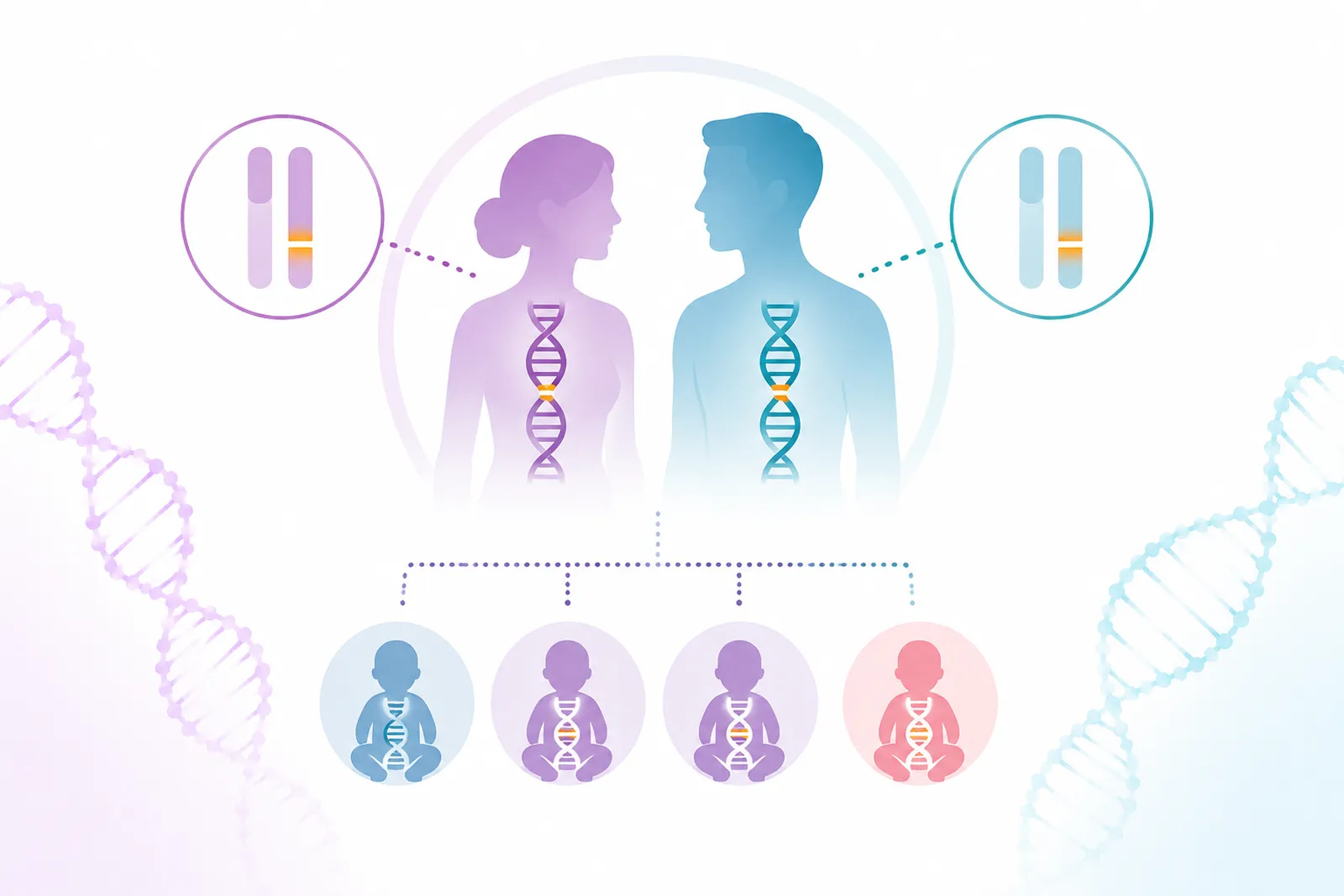
Every person is usually an unaware carrier of several genetic mutations. If both partners carry the same mutation, there is a significant risk, approximately 25%, that the disease will manifest fully in their child.

Healthy carriers of genetic diseases are almost always asymptomatic, meaning they have no symptoms of the disease, and often have no family history suggesting the presence of the condition. Serious genetic diseases with a high carrier frequency, known as carriers, in the European population include cystic fibrosis, spinal muscular atrophy and fragile X syndrome.

Scroll down
Carrier tests

Carrier tests are intended for patients who:

1.

Have a genetic disease in the family

2.

Are in a consanguineous relationship

3.

Are planning a family and would like to know whether they are carriers of certain serious genetic diseases

4.

Want to know for the future whether they are carriers of specific mutations included in the tested gene panel

Types of testing panels

Carrier tests monitor medically significant inherited disorders caused by a change in a single gene, known as monogenic mutations, which may have a serious health impact on offspring. ReproGenesis clinic offers several types of testing panels focused on these disorders:

PANDA Basic panel: basic test

Testing of the 5 most common recessive, meaning hidden, diseases: cystic fibrosis (CFTR gene), spinal muscular atrophy (SMN1 gene), non-syndromic hearing loss (GJB2 gene), fragile X syndrome (FMR1 gene) and phenylketonuria (PAH gene). It also focuses on detecting thrombophilic mutations, meaning mutations that increase the risk of blood clot formation, and the most common genetic causes of infertility – the AZF gene in men and genes affecting response to hormonal stimulation in women.

PANDA carrier panel: extended test examining 110 genes

Testing of a selected set of genes to identify the most common and clinically significant inherited diseases with a high carrier frequency in the Central European population.

ILGA panel: extended test detecting genetic causes of infertility

Testing of 50 genes in women, for example in cases of egg maturation failure, fertilisation failure, arrest of embryonic development or recurrent pregnancy loss, and 70 genes in men, for example in cases of oligo-astheno-teratozoospermia, azoospermia, flagellar abnormalities, fertilisation failure or arrest of embryonic development.

PANDA Complete panel: comprehensive test – combination of PANDA carrier + ILGA

Testing of a broad spectrum of genes with the aim of comprehensively assessing reproductive risk.

Carrier tests

Next steps if a genetic variant is detected

If a mutation is found in one or more of the tested genes as part of a carrier test, it is advisable to test the partner with whom the patient is planning to start a family for the same mutations.

If the carrier test also detects a mutation in the same gene in the partner, the couple is recommended to undergo an IVF treatment cycle with preimplantation genetic testing of embryos (PGT-M) and to select for transfer to the uterus, known as embryo transfer, only embryos that have not inherited mutations in the tested gene from the parents.

If genetic testing (PGT-M) shows that an embryo has inherited a mutation from only one parent, such an embryo can be transferred. However, it is necessary to take into account that the child will also be a carrier of the given monogenic disease, like the parent.

Scroll down

Statistical data and disease probability

At present, approximately 8,000 monogenic inherited diseases are known, meaning diseases caused by a variant in a single gene, including recessive, meaning hidden, and dominant variants. In dominant diseases, the disease manifests when there is a variant in one of the two gene copies.

  • The risk of a recessive disease manifesting in offspring is 25% when both partners are carriers.
  • In a dominant genetic disease, the risk is 50%; in this case, the child either inherits the disease from an affected parent, or the disease appears "de novo" based on an acquired mutation in the genetic information of reproductive cells, meaning the egg or sperm.


  • Population studies show that the frequency of serious monogenic diseases is 0.36% per 1 million live-born children.
    0.8–1% of European couples carry a risk of having a child with a serious genetic recessive disease, meaning the child inherits the mutation from both carrier parents.
    Approximately 6% of children are born with a serious congenital defect of genetic or partly genetic origin.

Scroll down
Carrier tests
Decorative graphic
Donation coordinator

Mgr. Hana Ströer

IVF Coordinator

Hlinky 144, 603 00 Brno, CZ

Do you need more information?
Contact us!

Potřebujete více informací?
Ozvěte se nám!